Quality you
can measure.
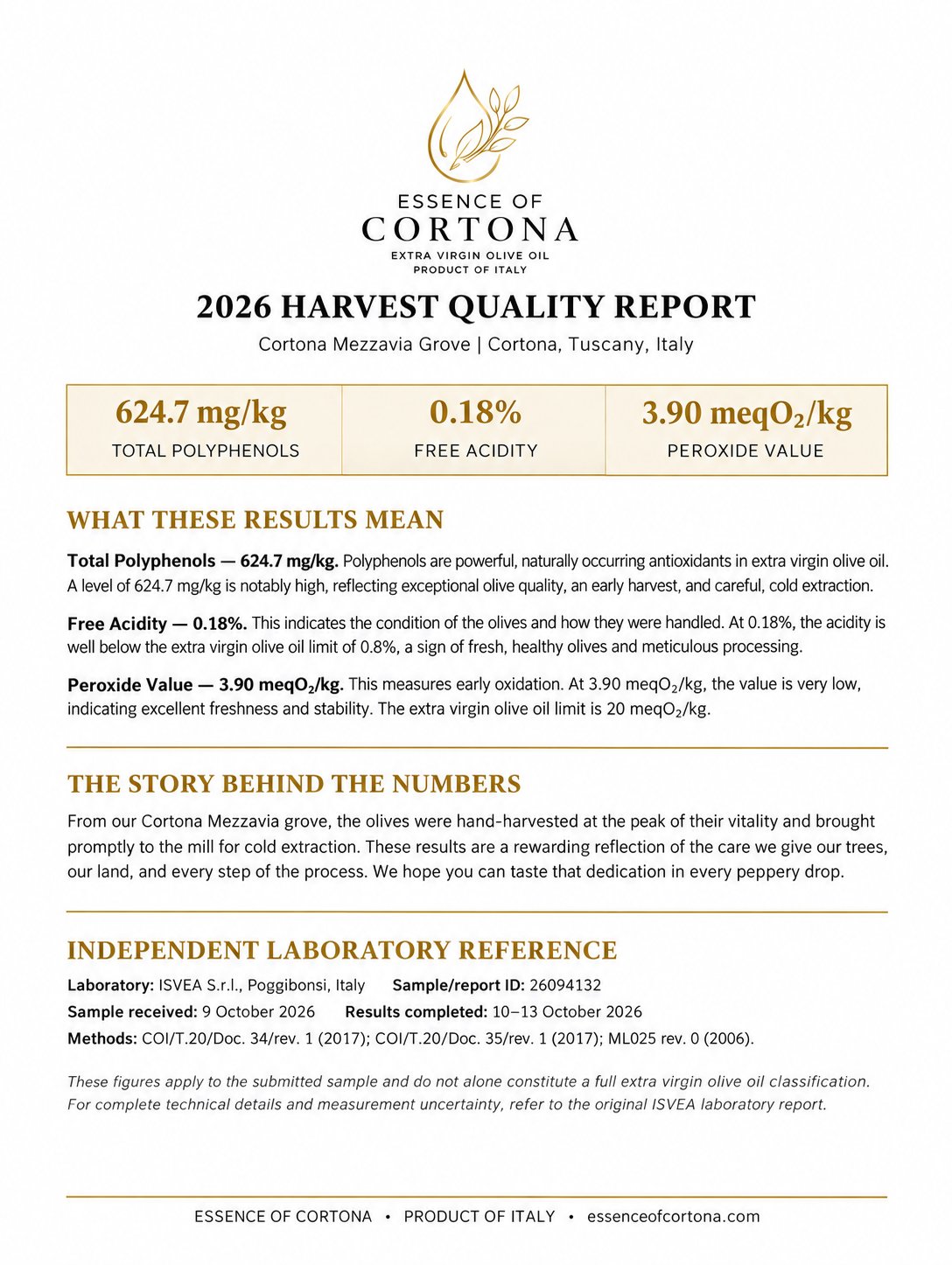
We don't want to ask you to believe our oil is exceptional. We want to show you the evidence. Each grove is harvested, pressed and tested separately, and here are the 2026 results, as the laboratories reported them.
Essence of Cortona.
From our Cortona Mezzavia grove, olives were harvested with care and brought promptly to the mill for cold extraction. These results are a rewarding reflection of the attention we give our trees, our harvest and every batch of oil.
EXTRAVAGANZA.
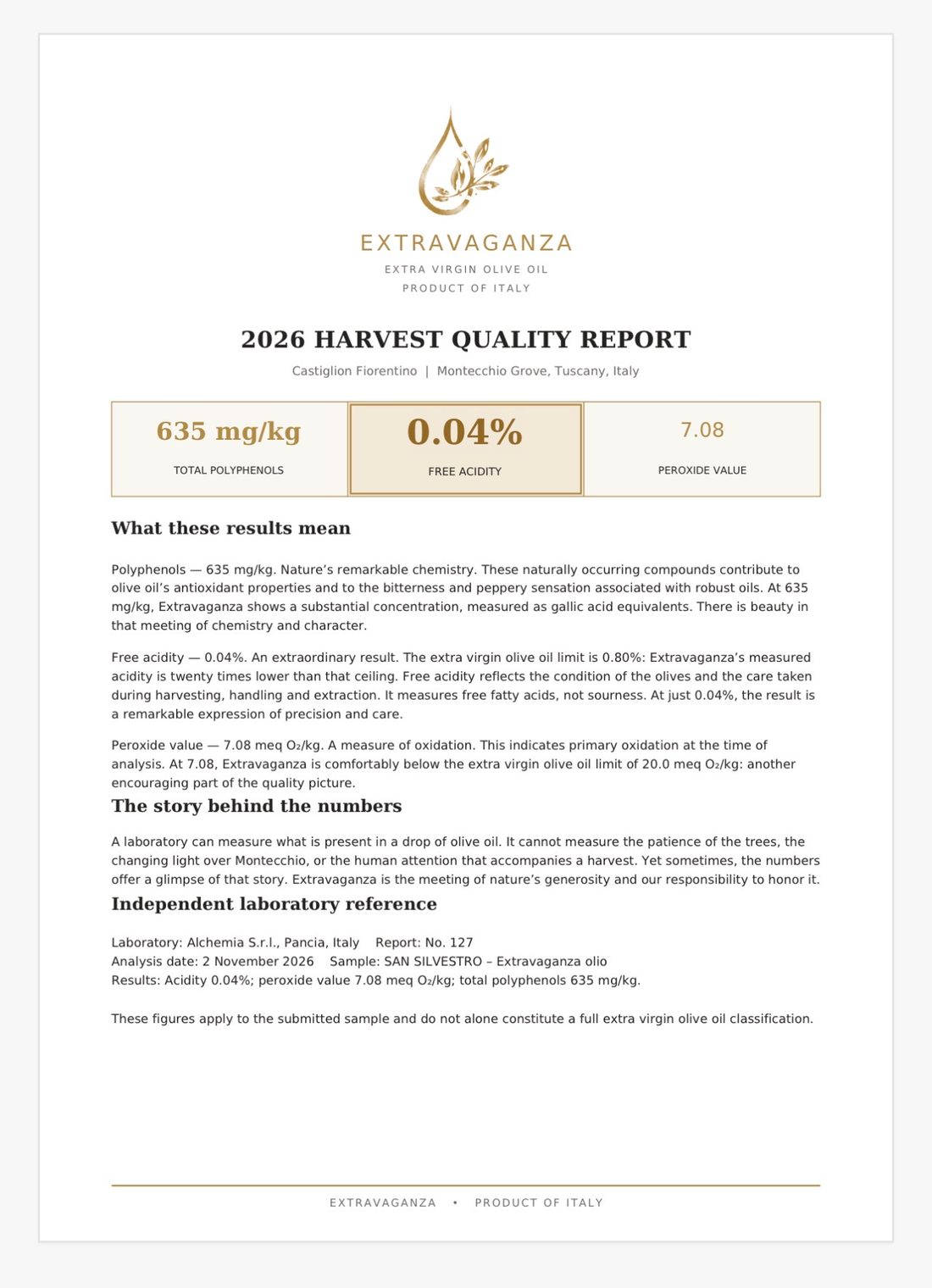
A laboratory can measure what is present in a drop of olive oil. It cannot measure the patience of the trees, the changing light over Montecchio, or the human attention that accompanies a harvest. Yet sometimes, the numbers offer a glimpse of that story.
Not sourness, care.
Free acidity measures free fatty acids in the oil. It reflects the condition of the olives and how they were handled. The limit for extra virgin olive oil is 0.80%; lower is generally better.
Character you can taste.
Naturally occurring olive compounds that contribute to antioxidant properties and to the bitterness and peppery finish of robust oils. Expressed by the laboratories as gallic acid equivalents.
A measure of freshness.
Primary oxidation at the time of analysis. The extra virgin limit is 20 meq O₂/kg; lower values mean less oxidation when tested.
These figures are the results for the submitted samples, analysed as received. They do not alone constitute a full extra virgin olive oil classification or a certification of specific health benefits. For complete technical details and measurement uncertainty, refer to the original laboratory reports. 2025 harvest (historical): 488.3 mg/kg total polyphenols · 0.25% free acidity; these earlier figures are shown for reference only.
What does free acidity mean in olive oil?
Free acidity measures the free fatty acids in the oil, not how sour it tastes. It reflects the condition of the olives and the care taken in harvesting and extraction. Extra virgin olive oil must be at or below 0.80%. Our 2026 Essence of Cortona measured 0.18%, and EXTRAVAGANZA 0.04%.
How many polyphenols does your olive oil contain?
Laboratory analysis of the 2026 harvest found 624.7 mg/kg total polyphenols in Essence of Cortona (Cortona Mezzavia grove) and 635 mg/kg in EXTRAVAGANZA (Montecchio grove), expressed as gallic acid equivalents.
What is the peroxide value?
The peroxide value measures primary oxidation at the time of analysis. The extra virgin limit is 20 meq O₂/kg. Our 2026 results were 3.90 for Essence of Cortona and 7.08 for EXTRAVAGANZA.
Where does your olive oil come from?
Essence of Cortona comes from our Cortona Mezzavia grove in Cortona, Tuscany. EXTRAVAGANZA comes from our Montecchio grove in Castiglion Fiorentino, Tuscany. Each is a single-grove oil, and we test and report them separately.
When was the oil harvested?
Our 2026 oil is an early harvest, picked in October 2026 with handheld combs and cold extracted below 27°C.
Which olive varieties do you grow?
Essence of Cortona is made from three traditional Tuscan varieties: Frantoio, Moraiolo and Leccino.
How should I store extra virgin olive oil?
Keep it tightly closed in a cool, dark place, away from the stove and sunlight. Our tins protect the oil from light. Once opened, enjoy it within a few months, while its aromas are at their best.
The science of
olive oil.
Polyphenols, antioxidants and what European and American regulators actually recognise.
Read the science ↗